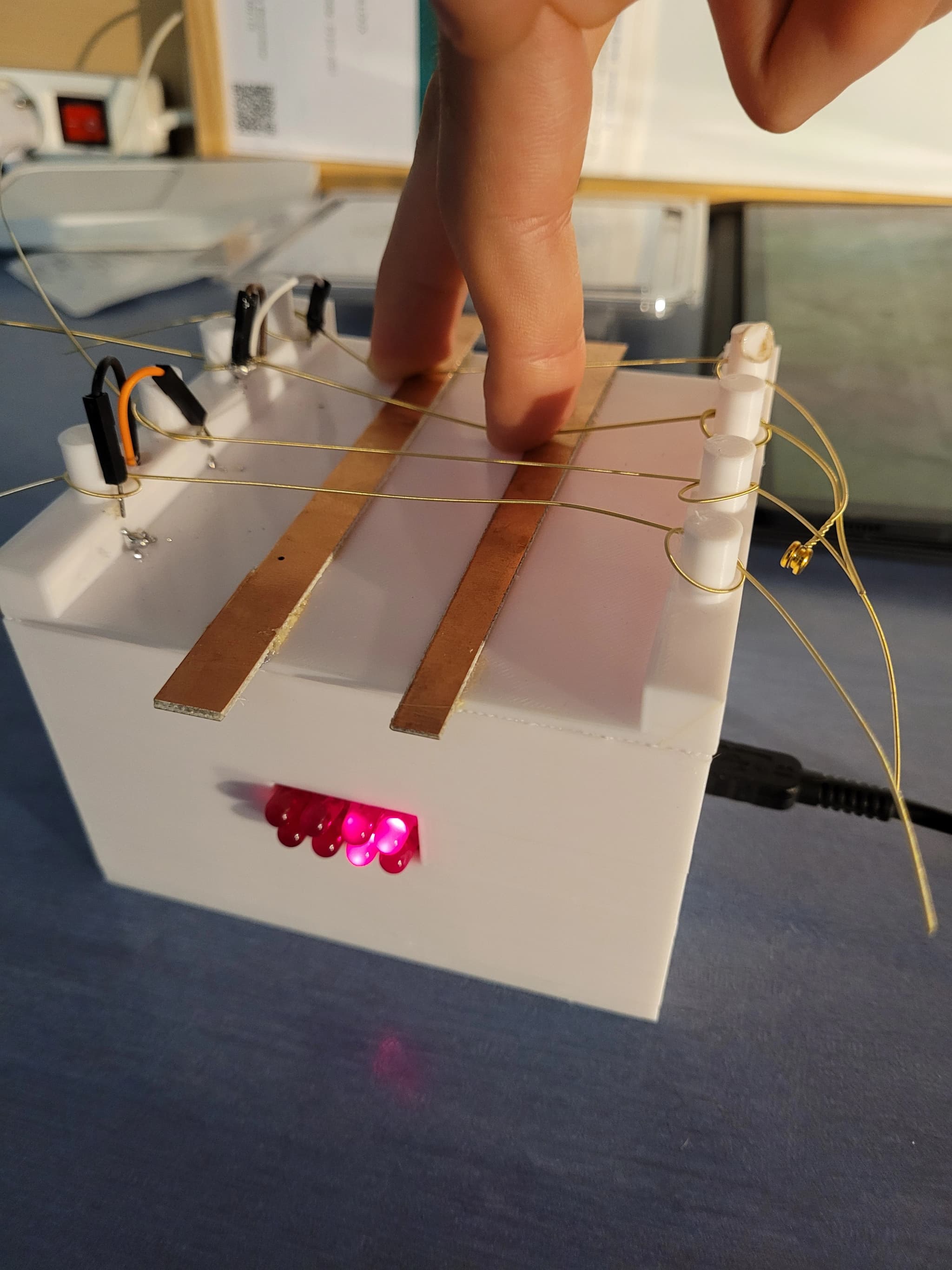
Training Guitar - Capacitive Sensors
Overview
Design of a training guitar for beginners using capacitive sensors to detect pressure on strings and frets. Real-time visual feedback via LED matrix to help novice guitarists position their fingers correctly.
Problem Statement
Learning Challenge
Learning guitar, while facilitated by online tutorials (YouTube), remains difficult for beginners:
- Pressure on strings must be correct to obtain the right sound
- A beginner without musical ear cannot easily detect if pressure is insufficient
- Notes sound wrong but the error is difficult to identify
Question
How to help a beginner know if they are pressing the guitar strings correctly?
Innovative Solution
Principle: Capacitive Sensors
Guitar strings and frets are metallic → use as 1-electrode capacitive sensors:
- Positive electrode: String or fret (5V applied)
- Negative electrode: Guitarist's finger (ground)
- Contact modifies capacitance detectably
By combining string + fret information, we can identify which note is played.
Visual Display
4×2 LED Matrix (4 strings × 2 frets):
- Each LED represents a fretboard position
- LED on = string AND fret correctly pressed
- Advantage: Precisely locates error (vs OLED screen showing only note name)
Theoretical Validation
COMSOL Multiphysics Simulation
1. Guitar strings (2D)
- Modeling: Rectangle 0.5mm × 1m (nickel-plated steel)
- Parameter: Finger-string distance (0-20mm)
- Results:
- Contact: 5 nF
- No contact: ~10 pF
- → ×500 detectable variation ✅
2. Guitar frets
- Modeling: Rectangle 20mm × 30mm + string + finger
- Parameter: String/finger assembly ↔ fret distance
- Results:
- Contact: 3 nF
- No contact: ~10 pF
- → Detectable variation ✅
Prototype Architecture
Main Components
1. Sensors
- 4 guitar strings (shortened)
- 2 frets (metal pieces)
- = 6 capacitive electrodes
2. Conditioning Circuits
- 6 analog circuits (1 per electrode)
- Capacitance → square signal conversion
3. Microcontroller
- Nucleo64 L152RE (STM32)
- Timers for frequency measurement
- GPIO for LED control
4. 4×2 LED Matrix
- Real-time display
- 100Ω resistors
5. Integration
- Custom interface PCB (Kicad)
- 3D-printed enclosure
Conditioning Circuit
Operating Principle
Objective: Convert capacitance variation into square signal whose frequency reflects capacitance.
Architecture (3 Op-Amps):
-
Voltage divider bridge
- 5V → 2.5V (2× 10kΩ resistors)
- Follower for stability
-
Voltage/Current converter
- Constant charge current on electrode
-
Hysteresis comparator
- Triangular signal → square signal (0-5V)
- Thresholds: 0V and 5V
Mathematical relation:
C = 1 / (R₆ × F)
where F = square signal frequency
Simulation Validation (PartQuest)
- Finger-electrode distance variation
- Conforming square and triangular signals obtained
- Resistor calibration validated ✅
Implementation
- Electrical schematic under Kicad
- PCB without vias for simplification
- 6 circuits fabricated and tested
STM32 Programming
Nucleo L152RE Configuration
Timers (Input Capture Mode with interrupts):
- TIM5 (32-bit, high precision): 2 channels
- TIM2/TIM3 (16-bit): Additional channels
- Interrupt on rising edge of square signal
GPIO:
- 8 outputs for 4×2 LED matrix control
Detection Algorithm
1. Capacitance measurement
- Frequency calculation in interrupt callback
- Averaging to smooth values
- Period → capacitance conversion in
whileloop
2. Press detection
- Threshold: 30 pF (between 10pF idle and 3-5nF contact)
- Double condition for LED:
- Fret touched (row)
- AND String touched (column)
Technical Limitations
- Only TIM5 high precision timer (32-bit)
- TIM2/TIM3 less precise (16-bit) → sometimes unstable values
- Sufficient for functional prototype
Technologies Used
Electronics: STM32 L476RG, TLC555 (oscillator), 4×2 LED matrix
Sensors: Capacitive sensors (strings and frets as electrodes)
Programming: Embedded C, timers, GPIO
Simulation: COMSOL Multiphysics (capacitive validation)
Future Prospects
Technical Improvements
Full guitar:
- More powerful microcontroller (more precise timers)
- Bluetooth module for smartphone transmission
- Mobile app displaying virtual fretboard
- Discreet integration in guitar body
Future Applications
1. Playing correction Detect accidentally touched neighboring strings that alter sound.
2. Score tracking App comparing in real-time what is played vs displayed score.
3. Automatic score generation Recording played notes → automatic score creation (solo memorization).
Learnings
Multidisciplinary Skills
Electronics:
- Analog conditioning circuit design
- Op-Amp and comparator mastery
- PCB design and fabrication
Embedded Programming:
- Timers in Input Capture mode
- Interrupt management
- Real-time signal processing
Physics:
- 1-electrode capacitive sensors
- Multiphysics simulations (COMSOL)
- Theoretical validation before prototyping
Prototyping:
- 3D printing for enclosure
- Mechanical/electronic integration
- Complete system testing and validation